
Jeromy Farkas won the mayoralty by 581 votes. That's fewer people than can fit in the lobby of the Jubilee Auditorium. It's the kind of margin that makes political operatives reach for the antacids — and it tells you almost everything you need to know about where Calgary is right now. A city split so cleanly down the middle that the difference between one future and another came down to a few hundred people who bothered to show up on a Monday in October.
On the night of October 20, 2025, Farkas became Calgary's 38th mayor and, in the same stroke, its first openly LGBTQ male mayor — bisexual, born in 1986 to Hungarian immigrant parents, raised in Dover. The symbolism writes itself. A fiscal conservative from the city's southeast, running on a platform of spending restraint, who also happens to represent a demographic breakthrough that would have been unthinkable in this city twenty years ago. Calgary has always been better at containing contradictions than resolving them.
The woman he defeated, Sonya Sharp, ran under the Communities First banner and came within a rounding error of the job. Jyoti Gondek, the incumbent, finished third with 71,397 votes — a rebuke severe enough to end a political career in most cities. Only four sitting councillors survived the same night. The most dramatic council turnover in recent memory didn't just change the faces around the horseshoe. It changed the gravitational centre of the entire conversation.
The budget as autobiography
Every new administration reveals itself in its first budget. Farkas's arrived on December 3, 2025, after eight consecutive days of deliberation and roughly fifty amendments — a legislative marathon that would have been impressive if it weren't also a preview of how difficult governing this council will be.
The headline number: a proposed 3.6% property tax increase was carved down to 1.64%, which works out to about $4.50 a month for the typical homeowner. To bridge the gap, council drew approximately $60 million from the Fiscal Stability Reserve — the city's rainy day fund — and killed the planned 1% tax shift from non-residential to residential property, ending a decade-long rebalancing policy in a single vote.
The Calgary Chamber of Commerce called it short-sighted. Defenders called it relief. Both are right, which is the nature of budgets in cities that want to be everything to everyone while spending like they're allergic to debt.
The more revealing vote came when council split 9–6 to eliminate $9 million in one-time climate and environment spending — solar panels, water conservation programs, the kind of unglamorous line items that don't win elections but do, over time, prevent the sort of infrastructure crises that define them. In a twist that would become characteristic, Farkas himself voted against those cuts. The mayor's own council overruling his preference on an environmental spending question tells you something about the political physics at work here: Farkas may be driving, but the passengers keep grabbing the wheel.
Then the pipe broke
On December 30, 2025 — the week between Christmas and New Year's, when no politician wants to be anywhere near a crisis — the Bearspaw South Feeder Main ruptured catastrophically. This is the pipe that delivers treated water to roughly 1.5 million people. It was the second failure in eighteen months, the first having occurred on June 5, 2024, under the previous administration.
An Independent Review Panel later found wire break rates approximately six times industry norms in the aging pre-stressed concrete cylinder pipe. The engineering is damning enough, but the political implications are worse: this wasn't a freak event. It was a predictable failure in a system the city knew was deteriorating. The panel's findings landed on a new mayor's desk like a test he hadn't studied for but was now expected to ace.
To his credit, Farkas moved fast. He called the repair effort "our moon shot" — grandiose, yes, but not inaccurate — and fast-tracked a $200-million parallel steel replacement pipe. Stage A, involving microtunnelling, began January 23, 2026. Stage B, open-cut construction, starts in May. The target completion date is December 2026, which is ambitious in the way that all infrastructure timelines are ambitious until they aren't.
The larger number is the one that should keep Calgarians up at night: the city reports $18 billion in infrastructure assets rated poor or very poor. The Bearspaw failure isn't an anomaly. It's a symptom. Every property tax debate, every budget line cut, every draw from the Fiscal Stability Reserve exists in the shadow of that eighteen-billion-dollar figure. This is the inheritance that Farkas didn't campaign on but will almost certainly be judged by.
The rezoning war
If the water crisis is the defining practical challenge, the rezoning debate is the defining cultural one.
The previous council approved "Rezoning for Housing" in August 2024 — a citywide blanket rezoning to R-CG that permitted duplexes, rowhouses, and townhouses in formerly single-detached-only neighbourhoods. It was, depending on your perspective, either the most progressive housing policy in Calgary's history or an assault on neighbourhood character by a council that didn't listen to its constituents. Both camps showed up in large numbers, and neither has stopped showing up since.
On December 15, 2025, the new council initiated a process to potentially repeal the policy. A public hearing is scheduled for March 23, 2026 — a date that will test whether Farkas's council governs by conviction or by volume.
The stakes are concrete, not abstract. CMHC has warned that repeal could jeopardize $129 million in federal Housing Accelerator Fund money. Between October 2025 and January 2026, the city received 375 development permit applications related to the rezoning — a 27% year-over-year increase — as developers race to lock in permits before a potential repeal that, if passed, wouldn't take effect until August 4, 2026. The market has already priced in the uncertainty, which means the damage of indecision is being done in real time regardless of the outcome.
This is the story that touches everything else in the city's cultural life. Density is what makes walkable, mixed-use neighbourhoods possible. It's what sustains independent shops and galleries and music venues and the small restaurants that give a neighbourhood its identity. The rezoning debate is framed as housing policy, but it's actually an argument about what kind of city Calgary wants to be — and whether the people who already live here get to freeze it in amber for everyone who comes after.
The money squeeze from above
Farkas's most quotable moment so far didn't come from a council meeting. It came in response to the Alberta provincial budget, tabled February 26, which brought a $9.4-billion provincial deficit and a massive education property tax increase. Calgary's annual requisition is rising to approximately $1.2 billion — a 20% jump that translates to roughly $28 a month more on the typical homeowner's bill.
For context: the city's own increase was $4.50 a month. The province's is $28. But ask most Calgarians which level of government is raising their taxes and you'll get a confident, incorrect answer.
Farkas put it sharply: "We're getting very close, perilously close, to half of every property tax dollar being collected in Calgary going to the provincial government. If property taxes are being jacked up for Calgarians and that money is being spent elsewhere, we're just seeing another version of equalization."
That's a remarkable sentence from a conservative mayor about a conservative provincial government. It's the sound of municipal pragmatism colliding with provincial ideology, and it may be the clearest signal yet that Farkas's fiscal conservatism is rooted in a genuinely local perspective rather than party loyalty. Whether that distinction survives contact with the next election cycle is another question.
Meanwhile, Premier Danielle Smith has announced an October 19, 2026 referendum with questions about limiting government benefits for non-permanent residents — a ballot question that will land squarely on Calgary's multicultural communities and add another layer of tension to a city-province relationship that is already fraying.
The quiet good news
Not everything is conflict. In January 2025, the province announced $4.5 million in annual increases to Alberta Foundation for the Arts funding over three years, bringing the AFA budget to nearly $40 million annually by 2026. Maximum individual artist grants rose from $15,000 to $18,000. Locally, the City's 2026 Arts and Culture Microgrant offers $1 million for community art initiatives, and Calgary Arts Development is running a new Artist Development Microgrant with its first intake deadline on March 25.
These are not headline numbers. They won't break through the noise of broken water mains and rezoning shouting matches. But they represent something real: a funding floor that, however modest, gives working artists in this city something to build on. Whether the new council sees arts funding as investment or overhead will be one of the defining questions of the Farkas era — and the answer isn't obvious yet.
One hundred days in
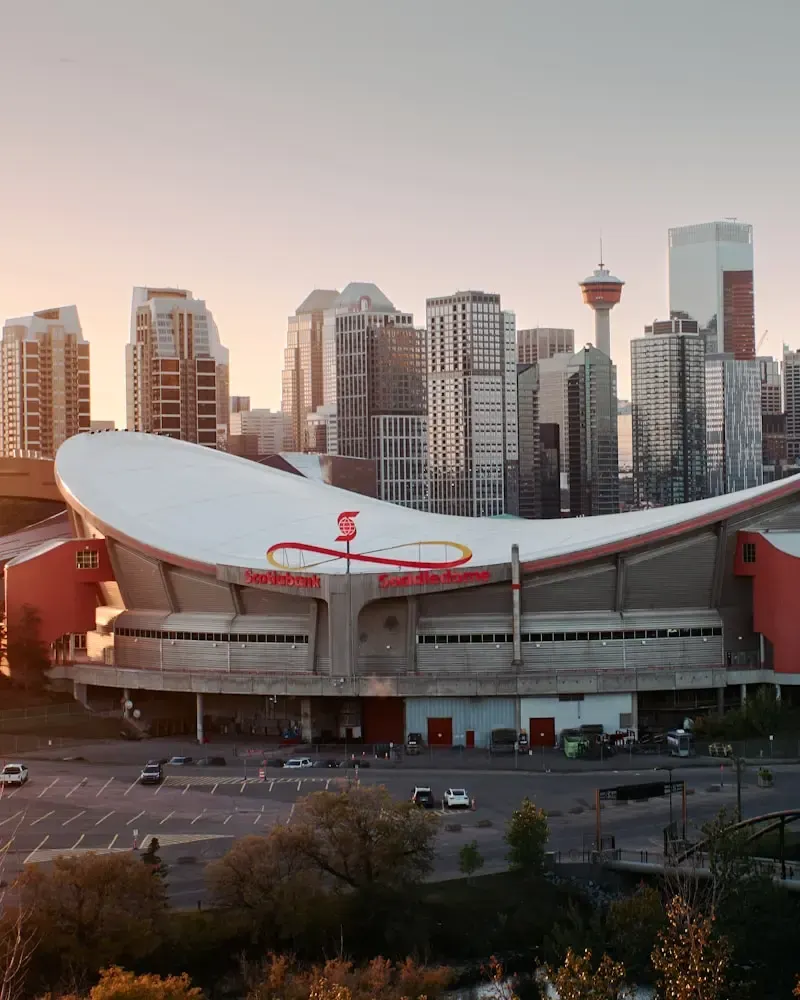
Jeromy Farkas inherited a city that is simultaneously building a $1.22-billion arena, a $660-million performing arts centre, and a $200-million emergency water pipe while sitting on $18 billion in deteriorating infrastructure, a 30% downtown office vacancy rate, and a council that can't agree on whether apartments should be allowed next to houses.
The contradictions are the point. Calgary has always been a city that builds before it plans, argues after it acts, and somehow muddles through with a combination of resource wealth, civic stubbornness, and the peculiar optimism of a place that rebranded itself "Blue Sky City" while its biggest industry still pulls carbon out of the ground.
Farkas didn't create these contradictions. But 581 votes made them his to manage. One hundred days in, the early reviews are mixed — pragmatic on infrastructure, ambiguous on culture, outflanked by his own council on environment, and surprisingly sharp on provincial overreach. It's not yet a legacy. It's a first draft.
The next chapter starts March 23, when the rezoning hearing opens and Calgary finds out whether this council governs for the city it has or the city it remembers.
The Chinook covers Calgary's arts, culture, and the politics that shape them. Subscribe for the stories the city needs told.