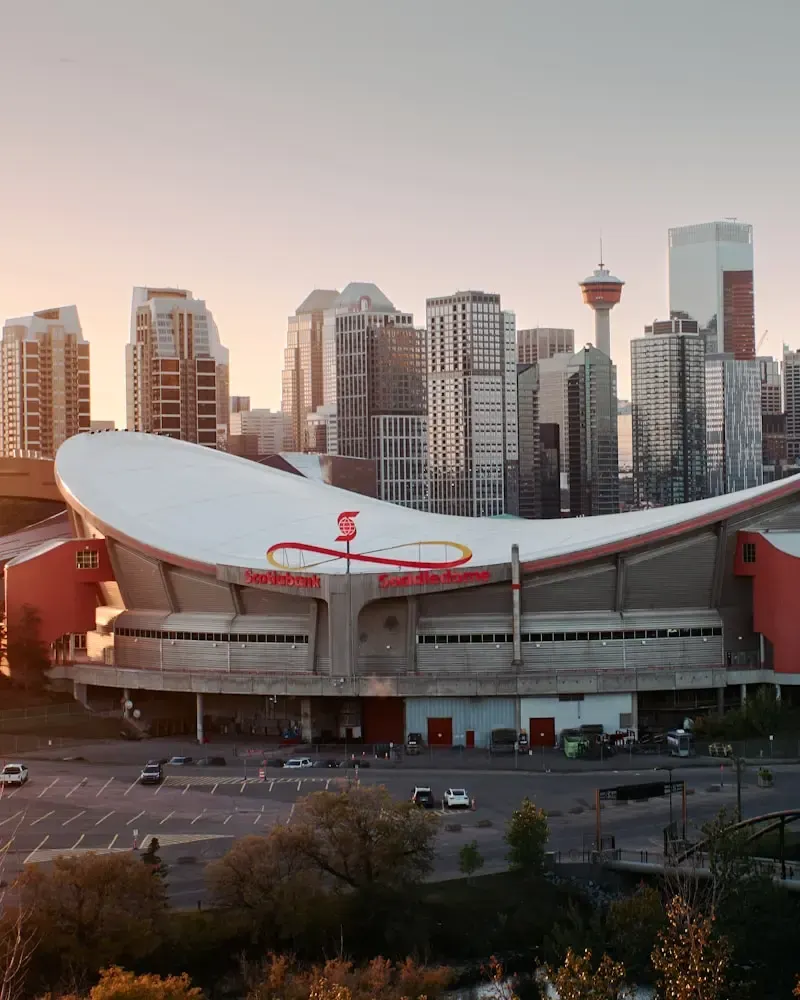

Calgary is simultaneously constructing a $1.22-billion arena and entertainment district, a $660-million performing arts centre transformation, and a $200-million emergency water main — while sitting on $18 billion in deteriorating infrastructure and a 30% downtown office vacancy rate. If ambition were currency, this city would be solvent. It isn't, and the math is starting to show.
The two cultural megaprojects — Scotia Place and the Werklund Centre Transformation — represent the largest coordinated investment in Calgary's arts and entertainment infrastructure in the city's history. Together, they will reshape the downtown core, redefine how Calgarians experience live performance, and either validate or demolish the thesis that cultural infrastructure can drive urban revitalization. The stakes aren't theoretical. They're fiscal, political, and existential.
Scotia Place: on time, on budget, no one believes it
The new Calgary Event Centre broke ground on July 22, 2024. The $1.22-billion project — which includes an 18,400-seat hockey arena, a 20,000-capacity concert venue, a 1,000-seat community arena, indoor and outdoor plazas, and a food hall — is reportedly on time and on budget. Steel superstructure is rising. Two hundred workers are on site daily. Opening is planned for fall 2027.
These claims are met with the healthy skepticism that any citizen who has lived through an arena deal deserves. Calgary's arena saga stretched over a decade of false starts, collapsed negotiations, public votes, and the kind of political theatre that makes actual theatre look understated. That the building is now physically rising from the ground feels, to many Calgarians, like the punchline of a joke they've been telling themselves for years.
But assume, for the sake of argument, that the timeline holds. Fall 2027 means the Scotiabank Saddledome — Calgary's primary large-venue concert space since 1983 — enters its final full year of programming in 2026. The farewell lineup reads like a generational accounting: Goo Goo Dolls with Dashboard Confessional, Diljit Dosanjh, Triumph, The Guess Who, A$AP Rocky during Stampede, Alanis Morissette. The building that hosted everyone from The Tragically Hip to Taylor Swift to the 1988 Olympics will be demolished after Scotia Place opens.
The concert capacity upgrade — from the Saddledome's 19,289 to Scotia Place's 20,000 — is modest in raw numbers but significant in configuration. Modern arena design means better sightlines, superior acoustics, flexible staging, and the kind of artist-friendly infrastructure that determines whether Calgary gets the A-list tours or the B-market routing. For a city that has watched major acts skip Calgary for Edmonton's Rogers Place since 2016, the competitive implications are real.
Werklund Centre: Canada's largest, and $200 million short
The more complex story is happening a few blocks away. The Werklund Centre Transformation — formerly Arts Commons — is a $660-million project that, when complete, will be Canada's largest arts-focused infrastructure development. The Phase 1 expansion, fully funded at $270 million, broke ground on December 11, 2024: a new three-level, 170,000-square-foot building with a 1,000-seat multi-purpose theatre and a 200-seat studio theatre.
The complex was renamed after the Werklund family's $75-million gift — the largest single donation in Canadian arts philanthropy history. The province committed $103 million over seven years. The ambition is extraordinary: a downtown performing arts campus that anchors Theatre Calgary, Alberta Theatre Projects, the Calgary Philharmonic Orchestra, and One Yellow Rabbit under a single, world-class roof.
But as of January 28, 2026, the project is nearly $200 million short of its total funding goal.
That gap is not a rounding error. It's the difference between a transformational campus and an expensive Phase 1 with no guarantee of completion. CEO Alex Sarian is in active discussions with the federal government to match the province's $103-million commitment, but federal cultural infrastructure funding is competitive, and Ottawa's attention is not reliably focused on Calgary. A $63-million municipal pledge from the previous council administration remains unfunded — and the current council, which drew $60 million from the Fiscal Stability Reserve just to hold the property tax line, is not in a position to write cheques for cultural infrastructure.
CMLC President Kate Thompson has warned publicly that delays increase costs due to inflation. Every year the funding gap persists, the eventual price tag grows. This is the ratchet effect that kills capital projects: underfunding creates delay, delay increases cost, increased cost requires more funding, more funding takes longer to secure.
The gap between steel and ambition
The contrast between the two projects is instructive. Scotia Place is fully funded through a complex public-private partnership involving the City of Calgary, the Calgary Flames (Calgary Sports and Entertainment Corporation), and naming rights revenue. The money is committed. The construction is underway. The building will open.
The Werklund Centre is funded in phases, with Phase 1 secured but the full vision dependent on additional government commitments that haven't materialized. The project is architecturally ambitious, culturally essential, and financially precarious. It's the kind of project that, in a city with a more established philanthropic culture or a more generous federal funding environment, would have been fully capitalized before ground was broken. In Calgary, it's being built on faith and phased funding.
This is the tension at the core of the city's cultural infrastructure moment: the entertainment infrastructure gets built because it has a revenue model (tickets, concessions, naming rights, hockey). The arts infrastructure gets built if governments decide it matters, and governments decide things matter based on elections, deficits, and competing priorities — none of which currently favour a $660-million performing arts centre in a province running a $9.4-billion deficit.
What's at stake
If the Werklund Centre stalls at Phase 1, Calgary gets a new theatre building but not the transformational campus that was promised. Theatre Calgary, ATP, the CPO, and One Yellow Rabbit continue to operate in aging facilities that constrain their programming and limit their ability to attract touring productions and top-tier talent. The city misses the window to create a performing arts destination comparable to what Vancouver, Toronto, and Montreal offer — and that window, once closed, doesn't reopen for a generation.
If both projects complete as planned, Calgary's downtown enters 2028 with a new arena district, a world-class performing arts campus, a reimagined Glenbow Museum with free admission, the Central Library, Studio Bell, and the East Village development corridor. That's a critical mass of cultural infrastructure that fundamentally changes the argument for downtown — not as a place you commute to for work, but as a place you go because there's something worth experiencing.
Given that 30% of downtown office space is vacant, this isn't a nice-to-have argument. It's a survival strategy. Downtown Calgary cannot fill those towers with office workers alone — the hybrid work shift has made that structurally impossible. The alternative is a downtown that draws people for culture, entertainment, dining, and public life. That requires exactly the kind of infrastructure currently under construction.
The politics of paying for it
The Werklund Centre's funding gap is ultimately a political question, and the politics aren't encouraging.
The new city council demonstrated in its first budget that spending restraint is the dominant value — $60 million from reserves, $9 million in climate spending cut, a proposed 3.6% tax increase slashed to 1.64%. A council that operates this way is not going to fund a $63-million arts infrastructure pledge without extraordinary public pressure or a fundamental shift in how they conceptualize the relationship between cultural investment and economic return.
The province has committed its $103 million over seven years, but that commitment was made before the $9.4-billion deficit was announced. Provincial priorities shift with fiscal conditions, and the AFA's modest funding increase — welcome as it is — doesn't change the structural reality that Alberta has never treated arts infrastructure as a priority comparable to roads, hospitals, or pipelines.
The federal government is the last viable source for the scale of funding required, and federal cultural infrastructure programs are oversubscribed, competitive, and subject to the electoral calendar. Whether Ottawa writes a nine-figure cheque for a performing arts centre in Calgary depends on factors that have almost nothing to do with the merits of the project.
Building in hope
There's a particular Calgary quality to all of this — the willingness to break ground before the money is fully in hand, to start building and trust that the rest will follow. It's how the Saddledome was built for the Olympics. It's how the Central Library was built. It's how East Village was redeveloped. The city has a pattern of overcommitting and then finding a way to deliver, usually later and more expensively than planned, but delivering nonetheless.
Whether that pattern holds for the Werklund Centre is the open question. The $200-million gap is real. The political environment is hostile to large public spending. The fiscal conditions at every level of government are constrained. And the alternative — a half-built arts campus sitting alongside a gleaming new arena — would be the most Calgary outcome imaginable: entertainment fully funded, culture still waiting.
The next twelve months will tell the story. Either the federal commitment materializes and the full campus moves forward, or Phase 1 opens as a very nice building with a very visible gap where the rest of the dream was supposed to go.
Calgary has been here before. It usually finds a way. But "usually" is not a funding model, and $200 million is not a number that resolves itself through optimism.
*The Chinook covers Calgary's arts, culture, and the politics that shape them.*